Showing posts with label Religion. Show all posts

Saturday, 2 January 2016

Can Muslims wish you a Happy New Year?


A day or so ago I read a very interesting article by Dr Bilal Philips explaining why Muslims should NOT say Happy New Year....

http://www.bilalphilips.com/celebrating-the-new-year/

In summary, Muslims shouldn't wish anyone happy new year as it is essentially a throwback to paganism and the worship of a false god.  Perhaps you think this is "extreme"....I looked up where we get the word "January" from, it is derived from the Roman God "Janus", the supposed god of doors and gateways.  See the following tweet from the British museum.


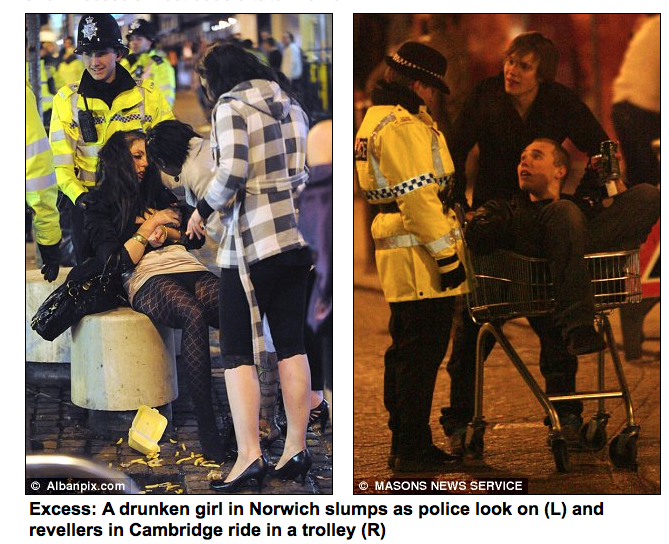
Apparently, the Romans celebrated the New Year with wild parties and orgies. At the same time as I noted this I noticed serval headlines on 1st January 2016 referring to the embarrassing culture of people being "wasted" as the celebrated the New Year.

Don't you find it a bit odd that so many people are actually following ancient pagan rituals (without them knowing this)? Putting aside the pagan origins of the New Year's Eve's celebrations, is this really a behaviour we can be proud of? Do revellers actually enjoy getting blind drunk? Embarrassing themselves?


It may at first seem mean spirited not to wish someone a Happy New Year, but certainly I would hope people could see why Muslims do not celebrate debauchery under the label of a false god.  As a Muslim I do wish everyone well but I cannot condone irresponsible celebration of at the New Year.

Thursday, 17 September 2015

Is Snapchat Satanic?


As a Muslim, as a believer, I belive in the "unseen". Part of the "unseen" is the world of the jinn and Satan (Iblis) and his jinn (demon) followers. The difficulty for a believer in such things is how to verify their existence? Can we prove the "unseen" exists? Certainly, an inability to prove something "unseen" doesn't mean it doesn't exist. Until our understanding of science developed we were unable to prove the existence of "unseen" things such as gravity and magnetism.

In this light I was disturbed to see Snapchat's recent introduction of allowing users to video themselves vomiting rainbows. I will say that again, vomiting rainbows. Maybe I am too old to understand (I am in my 40s) but why would someone want to see themselves vomiting a rainbow? The zombie face, I can understand. Change your appearance and shock your friends and family. But vomiting rainbows? What does it mean?

As far as I could find out vomiting rainbows means you find something too sweet - sickly sweet. Ok. But is this such a popular thing that it is added as a feature to Snapchat? Obviously it is. So why do people want to show themselves vomiting rainbows? The most popular answer I received to this question is that it is "fun". Really? This is fun? Maybe I don't have the right sense of humour to see the "fun" here.

Actually, I find the image shocking and, to me, Satanic. This depiction is what I imagine a demon to look like. I think this is the popular image that we all think a demon looks like. But how, have we ever seen a real demon?


Why do we think that demons have horns and big eyes? Just fantasy? We made it up? Collectively?

What about vomiting? I cannot think of anything positive about this. Of course the symbolism is unpleasant.


What I find strange is why would anyone want to depict themselves like this? Ok, maybe a few people perhaps, but such a number that it warrants its own application on Snapchat? Wow. This led me to thinking how did this come about. Certainly, to me, the depiction looks Satanic, it makes people look like demons. I have two thoughts on this. Say the "unseen" is true - that there really are demons - wouldn't they want their natural enemy - humankind - to depict themselves as demons? Who knows?

Putting the demonic copying to one side - isn't it that this is truly a waste of time? Does anyone need to send to another person a picture of themselves vomiting a rainbow?  In Islam, we believe that one of the tricks of Satan (Iblis) is to waste our time - preoccupy us with irrelevant and foolish matters. I think anyone reading this article who has teenage children will agree that whilst smart phones are incredible devices with very many wonderful uses - how often do our children waste their time with pointless activities on them? Could there be a more pointless activity than showing yourself vomit a rainbow?

One thing we can all agree on is that our time on Earth is limited. Again, we can agree we should use our time constructively and usefully. I don't think there is time for depicting ourselves vomiting a rainbow.


Tuesday, 15 September 2015

An inevitable clash between belief and science - virgin birth of Jesus


You might be surprised to know that the Quran refers to the virgin birth of Jesus.  In fact, it is a requirement of the Islamic faith to believe in this.

So how to reconcile a virgin birth with science? I don't think you can.  You can talk of assexual reproduction but do we have any scientific examples of this in humans? This is an issue that you either believe or you do not. There is no scientific basis (as we know to today) to explain this. So how come some people believe and others do not? This issue is dealt with in the Quran itself.

Quran - Surah Maryam 19:16 - 34

The Quran reveals that Mary was visited by the Angel Gabriel and she conceived a son.  Mary says

"How can I have a son, when no man has touched me, nor am I unchaste" [19:20].

When Mary is experiencing the pains of childbirth she says

"Would that I died before this and had been forgotten and out of sight" [19:23].

Why is Mary saying this? She recognises the embarrassment of her situation - she is chaste - untouched by man but yet she is pregnant. What will her family think? What will the community think? We can easily imagine her predicament even in our relatively liberal times.  Note that Mary wishes she was dead. Indeed, when Mary returns to her people with the new born Jesus they say

"O sister of Aaron (Harun), your father was not a man who used to commit adultery, nor your mother was an unchaste woman" [19:28].

What are her people saying to Mary? What is the inference? If we imagine any young girl in this position today what would you think? So you can see the question of believing the virgin birth was at the very beginning, at the time of Jesus' birth. No need for a scientific perspective, the inference is clear.

For a moment, imagine the event replayed today with someone you know, someone who you believe (or believed) was chaste. Would you believe them?  Would you think I believe that the young girl believes her story but maybe something happened that she didn't recollect?  What a test?

I believe Mary. Why do I believe Mary? I believe the Quran is God (Allah) inspired and it contains no errors. I also believe that this event (or story if you disbelieve) would not have been recorded in history if it didn't have other corroborating factors. Indeed, how many teenage pregnancies have occurred throughout the ages?  Why did this event (or story) stick? Why are we talking about it today? Well, it just so happened that the child born to Mary did turn out to be a very special man - I don't think there is much doubt or at least any evidence to show that Mary was not the mother of Jesus. Isn't it a coincidence that the boy born of virgin birth came to be a significant figure in our history (not to mention the three main monotheistic religions of Judaism, Christianity and Islam). Doesn't this mean something? Isn't it a bit more than a coincidence?

Have you any experience of speaking to an innocent person charged with a crime but they cannot prove they didn't do it? Usually, there will be additional data points to point to the truth. Is the person usually honest? Science cannot in all circumstances determine the truth of a particular event.

What I find amazing about the mentioning of the virgin birth of Jesus in the Quran is that it (to my mind) succinctly describes Mary's predicament. Imagine, Mary, the mother of a prophet, visited by the Angel Gabriel, wishing she was dead because of her virgin pregnancy. The Quran shows that this was a difficult matter to explain. Look at the reaction of Mary's people.

"O sister of Aaron (Harun), your father was not a man who used to commit adultery, nor your mother was an unchaste woman" [19:28].

What are Mary's people saying? We can imagine.

So, do you believe in the virgin birth of Jesus? Science will not help you believe. All we have to go on is that Mary was reported to be a young girl of unblemished character, a pious young lady. We have her word (assuming you don't doubt that she claimed this). We have the fact that the child born of the event was a remarkable figure. A coincidence? And for Muslims, we have this recorded in the Quran which we believe to be the infallible word of God (Allah).

I would be interested to know if Christians believe in the virgin birth? Do they really believe? Notwithstanding the fact that to believe is to fly in the face of our scientific understanding today. For those who do not believe what are they saying? What is the evidence not to believe Mary?

--------------------------------------------------------------------------------------------------------------------------

After posting this post I received a good deal of feedback as to why some people do believe Mary and the virgin birth of Jesus. Let's look at how such people believe?

Well, let's look at the facts.  That's right, FACTS.  The fact is that Mary gave birth to a significant person in history. Putting aside whether Jesus was a prophet (as believed by Muslims) or son of God (as believed by Christians), Jesus is an amazing historical figure. How many of us know of Jesus? How many other historical figures do we know?  What are the chances of a claim of virgin birth AND the child who is born of such birth being such a remarkable figure?  When we say remarkable, how remarkable? Well, a person who has a religion based on him - that religion is the largest in the World - plus Jesus is honoured in the second largest religion in the World. So when we say a significant historical figure - perhaps one of the most significant historical figures.

Is all of this a coincidence? It would be such a remarkable coincidence that you have to say that a coincidence is unlikely.  Surely, more than coincidence?  So if not coincidence?


Thursday, 10 September 2015

Does the finding of an extinct human like species really mean that there isn't a creator?


The Independent ran an article today with the heading "Sorry creationists, but scientists have found an entirely new species of human" (see the above screen shot).

http://i100.independent.co.uk/article/sorry-creationists-but-scientists-have-found-an-entirely-new-species-of-human--ZJG6L_Gk8e?utm_source=indy&utm_medium=top5&utm_campaign=i100

This led me to ask myself - is this really the case? Does the finding of an extinct species mean there is no creator? Well, I don't think this is the case. From a scientific perspective, there is no "science" to prove that there is no creator. At best, the case is inferential, the inference being that humans gradually evolved from pre-human species. Again, what is the scientific evidence for this? I think it is fair to say that this isn't conclusive.

The fossil record hasn't really shown the gradual evolution - the fossil record seems to show long periods of stasis (no change) with species appearing fully formed and then departing into extinction. Defenders of the view that there is no creator (based on the inferences of evolution) say that we are lucky to have the fossils that we have and that it would be foolish to think we will ever have a complete record to show the gradual evolution of one species into another. However, such a view of itself isn't "scientific".

From an Islamic perspective it is clear that Allah created man.  Does this mean Allah created man by the process of evolution and natural selection? Was man placed on the Earth fully formed? These are questions I will explore and hopefully proffer an answer. Certainly, for now, I don't think we can say that the finding of extinct human like species means that there isn't a creator.


Wednesday, 9 September 2015

The World couldn't have been created by chance could it?

The World couldn't have been created by chance could it?


I am currently working on writing a book to explain how people believe there is a God. In my efforts to write my book I have been reading up on scientific discoveries and how "believers" see these as signs of God - an intelligent creator/designer.

As part of my reading  I came across the above article entitled "How the World's most notorious atheist changed his mind". I was interested to read that Mr Antony Flew changed his mind about the existence of a god because he felt that the complexity of life and the universe could only be explained by the existence of an intelligent source.  He concluded that to suppose life and the universe came about by accident or chance was illogical.

Here is an extract from the article:

Dr. Benjamin Wiker: You say in There is a God, that "it may well be that no one is as surprised as I am that my exploration of the Divine has after all these years turned from denial...to discovery." Everyone else was certainly very surprised as well, perhaps all the more so since on our end, it seemed so sudden. But in There is a God, we find that it was actually a very gradual process—a "two decade migration," as you call it. God was the conclusion of a rather long argument, then. But wasn't there a point in the "argument" where you found yourself suddenly surprised by the realization that "There is a God" after all? So that, in some sense, you really did "hear a Voice that says" in the evidence itself "'Can you hear me now?'"
Antony Flew: There were two factors in particular that were decisive. One was my growing empathy with the insight of Einstein and other noted scientists that there had to be an Intelligence behind the integrated complexity of the physical Universe. The second was my own insight that the integrated complexity of life itself—which is far more complex than the physical Universe—can only be explained in terms of an Intelligent Source. I believe that the origin of life and reproduction simply cannot be explained from a biological standpoint despite numerous efforts to do so. With every passing year, the more that was discovered about the richness and inherent intelligence of life, the less it seemed likely that a chemical soup could magically generate the genetic code. The difference between life and non-life, it became apparent to me, was ontological and not chemical. The best confirmation of this radical gulf is Richard Dawkins' comical effort to argue in The God Delusion that the origin of life can be attributed to a "lucky chance." If that's the best argument you have, then the game is over. No, I did not hear a Voice. It was the evidence itself that led me to this conclusion.
http://www.strangenotions.com/flew/
The ironic thing is that many seem to point to science as a basis for their disbelief in God (intelligent designer) however the science doesn't disprove the existence of God.
Quran 3:190
3:190
Sahih International
Indeed, in the creation of the heavens and the earth and the alternation of the night and the day are signs for those of understanding.


Wednesday, 4 March 2015

Is being offended by how someone dresses ever ok?


On the 4th March 2015, the Independent newspaper commented on Professor Richard Dawkins' Newsnight interview with Evan Davis. In the interview, Professor Dawkins said he was personally offended by burqas.  This led me to think, is he really offended by burqas or is he perhaps offended by the reasoning behind why he believes people (ladies) wear burqas.

I doubt that Professor Dawkins is offended by clothes that cover the body. I suppose he isn't offended by a space suit or a diver's frog suit. Same for a balaclava when it is cold in winter. Also, would he be offended by traditional Arabic dress for men which also covers the body?  I would doubt it.


I really don't see how someone can be offended by clothes or more precisely by wearing clothes that covers the entire body. The offence must be at the reason why someone dresses the way they do. But this is a tricky area when a man comments on what he thinks a woman should wear or he is offended if she dresses in a certain way. I wonder what clothing a woman could wear which doesn't offend Professor Dawkins.

The comment from Professor Dawkins reminded me of a joke. It went as follows:

3 ladies were interviewed by a male store manager for a job as a cashier. In each interview, the ladies were asked what would they do if when they cash up their till at the end of the day there is a surplus of US$50 in the till. The first lady said she would keep the cash in her till and inform her boss the next day. The second lady said she would wait until the end of week and see what the discrepancy was before informing her boss. The third lady said that when she worked as a cashier before she would often use her own money for needed change and put it in the till so any positive discrepancy would be hers. Who got the job?

The lady wearing the tightest shirt.

This is a joke to show obvious sexism which is deplorable. But I would ask is it ok to be offended by the fact someone is covering themselves? Can you allow this to creep into your judgment when you are conducting an interview? Can you actually remove your personal offence from such a situation? Indeed, in the interests of avoiding sexism, isn't it unhealthy to hold such a view or at least unhealthy to pre-judge why people dress the way they do?


Wednesday, 11 February 2015

Don't hate debate - can you ridicule and not hate?


Following on from the horrible Charlie Hebdo atrocity there seemed to be little restriction as to what constitutes freedom of speech and freedom of expression. Where do we draw the line? Should there in fact be a line?

I certainly believe that all views should be allowed, but such views must be offered in a sensible and responsible manner.  Do we have the full freedom to offend? What if an unfettered freedom to offend  incites hatred and the carrying out of hate crimes?

I think certainly that the more responsible amongst us have a greater duty of care to ensure that opinions are expressed in a civil and respectful way, especially given the sensitivity involved.

Today, three innocent Muslims were murdered in the US in what has been headlined as being committed by a suspected "anti theist". Professor Richard Dawkins, to his immense credit, immediately condemned the murder.

http://www.independent.co.uk/news/people/richard-dawkins-condemns-chapel-hill-shooting-suspected-to-have-been-carried-out-by-antitheist-that-left-three-muslims-dead-10037983.html

As at the time of writing I don't know if today's killings were carried out by an "anti theist" and I certainly don't know his motivation. That said, perhaps the killings should encourage those who are engaged in the debate about the existence of God to act in a sensible and responsible manner and certainly not in a way that could incite hatred and/or hatred by others.


In my blog, I try my utmost to be respectful. I do not think lesser of someone who does not believe in God, I do not hate them. Indeed, I have been surprised at the nasty comments I have received to my blog which I assume stems from a reader's disagreement to my belief in God. Where does that venom come from? You can be passionate about a belief (or disbelief) but this shouldn't lead to hatred or the incitement of hatred in others and I think the higher your profile you have the more you need to think about how others might interpret your actions.

In the context of Professor Richard Dawkins, he is passionate about his beliefs and I respect him for that. His books are thoughtful (although I don't agree with his conclusions). That said, I don't think he needs to approach the subject with "ridicule" as he mentions on his Twitter profile.  We can lighten the debate with good humoured comments but "ridicule"?

rid·i·cule
ˈridiˌkyo͞ol/
noun
  1. 1. 
    the subjection of someone or something to contemptuous and dismissive language or behavior.
    "he is held up as an object of ridicule"
    synonyms:mockery, derision, laughter, scorn, scoffing, contempt, jeering, sneering, sneers, jibes, jibing, teasing, taunts, taunting, badinage, chaffing, sarcasm, satire; 
    informalkidding, ribbing, joshing, goofing, razzing
verb
  1. 1. 
    subject (someone or something) to contemptuous and dismissive language or behavior.
    "his theory was ridiculed and dismissed"
    synonyms:deride, mock, laugh at, heap scorn on/upon, jeer at, jibe at, sneer at, treat with contempt, scorn, make fun of, poke fun at, scoff at, satirize, lampoon, burlesque, caricature, parody, tease, taunt, chaff;
    informalkid, rib, josh, razz


One synonym for "ridicule" is "contempt". How far away is this from "hatred"?

ha·tred
ˈhātrəd/
noun
  1. intense dislike or ill will.
    "racial hatred"

To what extent can you have contempt for an idea and/or a belief but not have the same contempt for the person with the objectionable idea or belief? What if your contempt of an idea inspires someone to have contempt for the one who holds the objectionable idea?

Certainly, I don't intend to ridicule anyone's beliefs no matter how much I may object to them.

Indeed, there is also the danger that your views can be mis-interpreted.  Does this matter? Well, I suppose it depends on who you are. If you are a high profile figure who people respect, look up to and follow then I think it matters more.

Looking at Professor Dawkins' t-shirt - "Religion - together we can find the cure" - could this be misinterpreted? What is the cure? Medicine? Intellectual reasoning? When I first saw the t-shirt I thought of Sylvester Stallone.

Of course, you cannot be held responsible for the criminal acts of someone who plainly takes what you say and do out of context but I would have thought that leaders in this debate should debate with utmost responsibility. Does such responsibility allow for "good humoured ridicule"? Would be interested in the views of others.


Thursday, 22 January 2015

The Devil's Delusion - Atheism and its scientific pretensions - David Berlinski


A great read - an erudite and witty examination of a variety of arguments that science proves there is no God. David Berlinski shows from a scientific and philosophical perspective the case against God isn't anywhere near as conclusive as other "scientists" would have us believe.

It amazes me how the atheist scientists don't seem to address the weaknesses in their own arguments and from this they lose credibility.

David Berlinski makes the point (very neatly) that it is difficult to call our recent history "enlightened" when we consider the human suffering and misery of (amongst others) the first and second World Wars (70 million dead).

While there is debate as to whether Hitler was a believer (there seems no doubt that Stalin wasn't), David Berlinski makes the striking point that for those who carry out atrocities, it is unlikely that they "believe" that "God is watching".  If God isn't watching it means that there is no higher authority, therefore, no moral pause before you act. David Berlinski describes this as the "meaning" of a secular society.

What I like about David Berlinski's style is that he doesn't try to guilt you into believing what he believes or what he argues. Professor Dawkins in the Greatest Show on Earth compares people who do not believe in evolution as "history deniers" not dissimilar to Holocaust deniers. If Professor Dawkins has such a strong case for evolution why try to guilt people into believing?


Friday, 16 January 2015

The End of Faith by Sam Harris


I was planning on doing a full review of Sam Harris' book "The End of Faith" but after reading the first few chapters I felt that the book didn't deserve my time for a full review given its poor analysis. I did finish the book but have limited my review just to chapter 4 - The Problem with Islam - so as to give an idea of the inaccurate conclusions the book has.

Certainly as the book is from an atheist perspective I can expect some criticism of religion but what I found astonishing was the criticism, certainly with regards to Islam, was more prejudicial rather than an intelligent critique. Here is why I think that....

"...the Muslim world has no shortage of educated and prosperous men and women, suffering little more than their infatuation with Koranic eschatology, who are eager to murder infidels for God's sake."

Is this really true? What is this observation based on? I can say that I am a Muslim, have lived in the Middle East for about 15 years - I haven't come across educated and prosperous people who are "eager to murder infidels". In fact, just the opposite. I have met Muslims who are part of "dawah" (meaning invitation) organisations who invite people to Islam.

I found this statement shocking and really cannot think of another way to describe it than bigoted and prejudicial.

"We are at war with Islam"

Not sure who Sam is referring to when he says "We" are at war with Islam but it is ironic that he is essentially trying to portray Islam as an aggressive and violent religion and then he goes and declares that "We" are at war with Islam.  Bizarre.

"...war against infidels and apostates is a central feature of faith.."

Sam what have you been reading? How on Earth did you come to this conclusion about the religion of Islam? Really this is so far off the mark. Rather than me provide evidence to the contrary I would love to invite you to live as a Muslim for a week or a month so you can at least better see how Muslims see their own religion.

"...almost any act of violence against infidels can now be plausibly construed as an action in defence of the faith..."

Again, just not true.

"..the basic thrust of the doctrine is undeniable: convert, subjugate, or kill unbelievers; kill apostates..."

Again, not true. Does Sam think everyone in the Middle East is Muslim? Have all expats in the Middle East converted? How many apostates are there? How many are executed by the state?  Are Muslims really required to kill unbelievers? If you are an unbeliever and you are reading this do you know of a Muslim who tried or is trying to kill you?  This is very Fox News style bigotry and very poor in terms of the quality of analysis. Sam, couldn't you have looked a bit more at how Muslims consider their religion? Not saying you have to accept what they say but at least a little balance?

"Within the House of Islam, the penalty for learning too much about the World - so as to call the tenets of the faith into question - is death"

Come on Sam how on Earth can you say this? What did you base this comment on?  Really, in the Muslim world you can die for learning too much about the World? Who has died? In what circumstances? Actually this blog is proof against what you are saying. I am learning about the World and am currently learning about what atheists think.  I must say this quote was the one that turned me off from completing a full review of the other chapters of the book. If Sam cannot provide evidence for this outlandish comment why should I waste my time reviewing other such silly comments.

"If you believe anything like what the Koran says you must believe in order to escape the fires of hell, you will, at the very least, be sympathetic with the actions of Osama bin Laden..."

Goodness me! Imagine. I believe in everything that the Quran says! So what does that make me in Sam's eyes? Bloody hell. What utter nonsense. Please Sam, please live as a Muslim for a week or so. You will honestly get a better idea of how we think and then you will realise that we don't support terrorism.

"..the people who died on September 11 were nothing more than fuel for the eternal fires of God's justice..."

What can I say? Sam what do you base these ridiculous comments on?

Sam then recites a good number of sentences from the Quran - all out of context and with no explanation. Not even of the standard a school kid attending high school  would review a book for an English literature essay. Sam, have you heard of "tafseer"? It is the explanation and interpretation of the Quran to provide a proper and deeper understanding of the text.

"On almost every page, the Koran instructs observant Muslims to despise non-believers."

Again, not true!

The Quran essentially explains to humankind to believe in God (Allah), don't ascribe partners to him, to enjoin good and forbid evil, fast in Ramadan, don't tell lies, give charity and be kind to people. God (Allah) describes himself as the most merciful....certainly more merciful than any human including Sam Harris.

Quran Surah Zumar 39:53

39:53
Sahih International
Say, "O My servants who have transgressed against themselves [by sinning], do not despair of the mercy of Allah . Indeed, Allah forgives all sins. Indeed, it is He who is the Forgiving, the Merciful."

So where is Sam going with all this? Why put the case that Islam is deadly, violent and aggressive?

"Muslims might then come to see the wisdom of moderating their thinking on a wide variety of subjects . Otherwise, we will be obliged to protect our interests in the world with force -..."

How ironic, so Sam is saying to the Muslims, your religion is far too violent and aggressive so you need to moderate yourselves or else we will  "protect our interests...with force". So the peaceful one (Sam) is threatening the use of force. I wonder if Sam sees the irony of this - accuse a community of being aggressive (and therefore by implication the accuser is obviously peaceful) but then threaten the supposed aggressive community with violence.

Quran Surah Baqarah 2:11

"now when it is said to them do not do mischief on the Earth they say on the contrary it is we who are the peacemakers."

Sam doesn't sound like a peacemaker to me.

By the end of chapter 4 I decided to continue reading "The End of Faith" but not waste my time doing a review.  There is so much to point out as wrong in Chapter 4 that I would simply conclude that Sam does not understand how Muslims view their own religion. I say this as a Muslim, living with Muslims in the Middle East. My best suggestion for Sam is to live with Muslims for a week or so - I think from this he would get a better understanding of Islam and how Muslims view their religion.


Friday, 2 January 2015

Chapter 10 - The God Delusion Richard Dawkins - A Much Needed Gap


In the final chapter of the book Professor Richard Dawkins makes the point that the idea of God fills a gap in our lives in the same way that an imaginary friend fills a gap in the life of a child. Again, no scientific evidence for this - more of a thought and certainly not persuasive in putting across the view that belief in God is delusional.

Professor Dawkins then refers to the burka (a form of Islamic dress for women) and makes the point that while such form of dress covers the body except for a small slit for the eyes then this image can be used to show the similarity of a mind which excludes science. A bizarre analogy to me as it presupposes that Muslims have no belief in science (not true). Again, no science to support this point and again no real argument to support the title of the book whether a belief in a God is a delusional belief.

Professor Dawkins has a shot at the burka saying it is an instrument of oppression. Again, no evidence given for this. What clothing would be suitable or appropriate Professor Dawkins does not say. If a burka covers most of the body and therefore is a symbol or restricting the mind is a bikini a symbol of great learning and enlightenment? What about people in cold countries don't they need to cover up to keep warm? Are they also uneducated because of covering up?

A disappointing end to an interesting book.  Certainly, I am not convinced that a belief in a God (any God for that matter) is delusional per se. In fact, Professor Dawkin's acknowledgement of a possible existence of a God who made the laws of physics tells me that it is clear there isn't proof to say there is no God and it therefore follows that you cannot say that belief in God is delusional.  

Chapter 9 - The God Delusion - Childhood, Abuse and the Escape from Religion


Professor Richard Dawkins starts this chapter with a story about a girl set in the 1850s who was taken from her Jewish parents because she had been baptised by a maid and the result was that she was not allowed to be brought up by her parents - in turn Professor Dawkins expresses dismay about how the parents would't renounce their faith and become Catholic at least just for the sake to be reunited with their daughter - the conclusion - religion is bad and I guess it follows there is no God.  No science in this - a bit disappointing.

Professor Dawkins continues to question the practice of parents bringing up their children a particular religion and suggests that this is akin to child abuse.  He also seems to play down sexual abuse generally and in particular child abuse by Catholic priests and suggests that teaching about hell is perhaps a greater form of abuse.  Indeed, Professor Dawkins refers to the abuse he suffered and notes he has long forgiven the abuser.

In summary, I didn't find any science in this chapter to suggest that belief in God is delusional. With regard to Professor Dawkins' point that children should be taught to think for themselves and then decide for themselves - I think this is valid however you would have to expect that the parents/society will obviously tailor such education in what they think is in the best interests of the child. As a Muslim, I would certainly want my children to receive a broad education (obviously including science) but I would also want them to learn about my religion (Islam) as well as other religions. Certainly, Islam places on each individual the decision as to what they want to believe.


Tuesday, 30 December 2014

Chp 8 – The God Delusion – What’s wrong with religion? Why be hostile? – my initial thoughts


Chp 8 – The God Delusion – What’s wrong with religion? Why be hostile? – my initial thoughts

In this chapter Professor Dawkins explains why religion is not good for the World and gives a variety examples of where religion, in particular, fundamentalism and literal belief in holy books, has resulted in horrible acts. Professor Dawkins laments over the otherwise smart scientist who gives up a potentially successful life as a scientist because he believed the Old and New Testatments over scientific fact. Professor Dawkins also refers to terrorists acts such as 9/11 and the London bombings.

Professor Dawkins refers to the “dark side of absolutism” ….most dangerously so in the Muslim world”.  I was disappointed that the reference to the “Muslim world” isn’t supported with credible evidence other than references to the Taliban (Afghanistan), 9/11 and the London bombings. Certainly not a scientific approach but I would also add that I really do not think you can judge the Islamic faith by simply referring to a handful of terrorist acts and the failed state of Afghanistan that has been war torn for much of my life and has been the subject of proxy wars by other more powerful countries. Was Islam fine before 9/11, the Taliban and the London bombings?

Professor Dawkins concludes from the examples that he gives that “religion can be a force for evil in the world”. I don’t disagree but also it can be a force for good. Again, I was disappointed that there was insufficient evidence to support such conclusions. 

As I am writing my thoughts on this book and posting them to my blog one person who commented on my comments said that the God Delusion is like a “Turkey shoot” where you try to find logical and factual errors. I thought this was a harsh comment at the time but after reading chapter 8 I felt this comment had some validity to it. There are several incorrect (plainly wrong) and misleading references to Islam as follows –

1.     Prophet Muhammed did not invent Islam at the age of 40. Islam means submission to the will of God (Allah). Prophet Muhammed was a messenger following the long line of prophets who came to deliver the message to believe in God (Allah). This is what Muslims believe. It is incorrect to say that Islam was invented by Prophet Muhammed. Professor Dawkins is free to say this is what he thinks but this is not what Muslims think. A basic factual error.
2.     Professor Dawkins refers to the case in Pakistan where a man was questioned as to his motives to be a Muslim.  There is no validity to such questioning – it is known in Islam that no one knows the sincerity of another.
3.     Professor Dawkins likes assessing Islam by the seemingly outrageous law that apostates must be killed. As I understand it the death penalty for apostates is more akin to treason i.e. the disbelief has to be public and an overall threat to society and such punishment can only be sanctioned by the head of state. If someone disbelieves internally and privately no one would know. From my experience of living in the Middle East, I think there are lots of people who do not practice the religion, lots who don’t believe but nothing happens to them. There is no Islamic duty to kill apostates. This is another factual error. If someone kills someone else it is murder – simple as that.  Just like in the UK if a murderer tells us that God told him to kill, we don’t accept that as a basis to criticize religion – it shows the killer is a murderer and possibly insane.
4.     How does Professor Dawkins know that the Taliban takes the Quran literally? Why are the Taliban poster boys for the Islamic religion? In the Middle East we take no guidance or direction from the Taliban. Who are the Taliban anyway? How would Professor Dawkins analyse Islam before the Taliban?
5.     What Islamic fascist state is ardently sought? Most of my Muslim friends in the Middle East enjoying living and holidaying in the UK, Europe, the USA.
6.     Professor Dawkins refers to militant Muslims living in Britain who consider themselves bound by Islamic law and not the laws of the UK. Islamically, you are obliged to follow the laws of the land where you live.
7.     Referring to Sam Harris and how Sam Harris says the 19 bombers on the 9/11 planes believed the literal truth of the Koran – how does Sam Harris know this? Comical and certainly no evidence of there not being a God. Where has the scientific analysis gone?
8.     Again Sam Harris, and Sam’s interview with a failed suicide bomber – my understanding is that there are a variety of reasons for suicide bombing – mainly born out of fear, frustration, oppression and certainly this is not prescribed in Islam – of course no reference in the Quran to suicide bombing.
9.     Where are the contradictions in the Quran referred to by Sookdeo? Where in the Quran does it say any Muslim who denies terror is part of Islam is a disbeliever? Utter nonsense.

Overall, I was disappointed with this chapter. I certainly do not mind a critique of the Islamic religion but please a more well thought out critique based on an analysis of the texts and not just references to the Taliban, 9/11 and the London bombings. Also, to get back to the central theme of the book, where is the connection between instances of evil and the existence of a God? I don’t think any of the faiths/believers in a God ever suggested that a hallmark of God’s existence is an absence of evil. Isn’t the presence of evil part of the test God has set for us in this World? Anyhow, disappointed with this chapter for its lack of intellectual rigor. These are the types of arguments you would face from anyone.